How to Sell Seasonal Digital Products on Shopify in 2026 (Reviews and Pricing)
Plan seasonal digital product launches all year with this Shopify calendar.
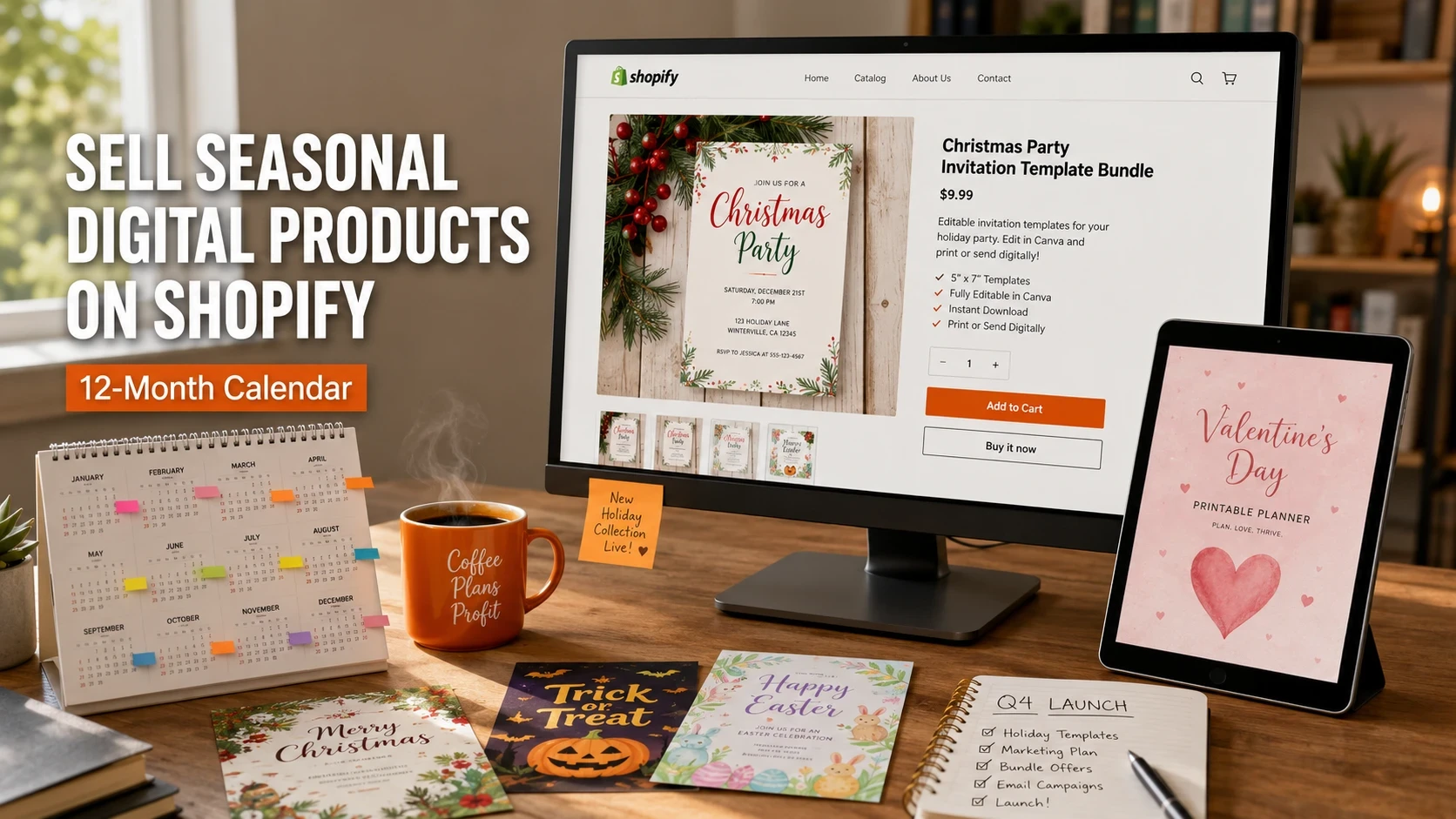
A printable planner designer doing $400/month in steady sales watches revenue spike to $2,800 every January, then flatline by March. A holiday card template seller earns 80% of annual income in six weeks between October and December. Both creators are leaving money on the table because they treat seasonal demand as a bonus instead of a business model. The truth is that seasonal events happen every single month, not just during Q4. If you plan your product calendar around them, you can turn sporadic spikes into predictable, year-round revenue. This article gives you a 12-month calendar, product ideas for each window, and the exact setup to sell seasonal digital products on your Shopify store.

The economics of seasonal digital products are different from evergreen ones, and in some ways, better. Evergreen products (budget spreadsheets, resume templates) sell steadily but face constant competition from thousands of near-identical listings. Seasonal products face a narrower window but also a narrower competitive field, because most sellers don't plan far enough ahead.
According to data from Etsy, seasonal printable listings generate some of the highest per-listing revenue on the platform. Holiday planners, party invitation templates, and seasonal wall art packs routinely appear in top-seller roundups because demand is concentrated and urgent. Buyers searching for "Christmas party invitation template" in November aren't browsing casually. They need something now, and they'll pay full price for it.
There are three reasons this matters for Shopify sellers specifically. First, you own the customer relationship. Unlike marketplace sellers who lose the buyer after checkout, a Shopify store lets you email that Christmas buyer again in February with Valentine's Day products. Second, you control your pricing. No race-to-the-bottom marketplace fees eating into a $4.50 printable. Third, you can bundle. A holiday marketing template pack with Instagram posts, email headers, and gift tags priced at $29 beats three separate $7 listings every time. If you want more ideas on what kinds of digital products consistently sell, our guide on digital product ideas that sell: 20 proven examples covers the full landscape.
The biggest mistake seasonal sellers make is starting too late. Buyers begin searching for seasonal products 6 to 8 weeks before the event, and Shopify SEO needs time to index your product pages. Here is a month-by-month calendar showing what to create and when to list it.
January is the biggest month for planners, goal-setting worksheets, budget trackers, and "new year, new me" productivity templates. List these by mid-November. A fitness creator selling a printable 12-week workout plan with meal prep templates can price a bundle at $19 to $29 and ride the New Year's resolution wave through February.
February is Valentine's Day territory. Greeting card templates, love coupon booklets, date night planners, and Valentine's classroom printables for parents of school-age kids all perform well. The classroom printable niche is especially underserved on Shopify compared to Etsy.
March brings St. Patrick's Day (party printables, green-themed wall art) and the start of spring cleaning. Spring cleaning checklists, home organization printable kits, and Marie Kondo-style declutter guides sell to a practical, action-oriented buyer.
April means Easter and spring. Egg hunt planning kits, Easter basket gift tags, spring garden planners, and printable Easter activity packs for kids. Also: Tax Day in the US, which creates demand for financial organization templates and small business tax prep checklists.
May is Mother's Day, Teacher Appreciation Week, and graduation season. Editable Canva card templates, printable gift certificates, and graduation announcement templates sell briskly. Mother's Day is the third-largest gift-giving holiday in the US.
June brings Father's Day, wedding season (which runs through September), and the start of summer. Wedding planning templates, summer bucket list printables, and camp activity packs for kids are all in play. Wedding-related digital products on Etsy command premium prices, often $15 to $49 for comprehensive planning bundles.
July is summer vacation peak. Travel planners, packing checklists, summer reading logs for kids, and Fourth of July party printables (for US-based sellers). This is also a great time to create your Q4 products while sales are slower.
August is back-to-school, one of the largest seasonal events for printable sellers. Teacher classroom decor bundles, student planner templates, school supply checklists, and homeschool curriculum planners. List these by late June.
September starts the fall season. Fall bucket list printables, autumn wall art, and early Halloween prep materials. September is also when you should start listing your Q4 holiday products for SEO indexing.
October is Halloween. Party invitation templates, trick-or-treat planning kits, Halloween coloring pages, costume planning checklists, and spooky-themed wall art. Halloween traffic on Etsy reportedly starts picking up as early as July, so early listing is critical.
November is Thanksgiving and, more importantly, Black Friday/Cyber Monday. Gratitude journals, Thanksgiving meal planning printables, and holiday shopping budget trackers. This is also when you should run your biggest seasonal sale on existing products.
December is the peak. Christmas card templates, holiday planner bundles, printable gift tags, advent calendars, New Year's Eve party kits, and holiday marketing template packs for small business owners. One seller on Etsy reportedly earned over $65,000 in a year selling printable home management binders with seasonal page inserts.
Not every seasonal product is worth making. The ones that sell share three characteristics: they solve a specific problem, they save the buyer time, and they look good enough that the buyer would feel embarrassed making it themselves.
The most efficient seasonal sellers don't design from scratch every month. They build a core template system and reskin it. A party invitation template built in Canva with swappable color palettes, fonts, and graphics can become a Valentine's Day invite in February, an Easter invite in April, a Halloween invite in October, and a Christmas invite in December. Four products from one design system.
This is exactly the strategy that successful printable sellers use. Rather than creating 100 unrelated products, they create cohesive collections that share a visual identity. Buyers who purchase your Christmas party kit come back for your Valentine's Day kit because they recognize your style.
Most seasonal digital products work best as PDFs (for printables), Canva template links (for editable designs), or PNG/SVG files (for sublimation and craft sellers). If you're selling ebooks or guides, check our detailed walkthrough on how to sell ebooks and PDFs on Shopify for format-specific guidance.
Before creating a seasonal product, check if people are actually searching for it. Search Etsy for the product category and look at how many results appear and how many reviews the top listings have. If "Christmas budget planner printable" shows 10,000+ results with top sellers at 5,000+ sales, there is proven demand. If "Arbor Day printable worksheet" shows 47 results with the top seller at 12 sales, it might not be worth your time.
"I want to create a seasonal [product type] for [specific audience]. What are the top 3 variations that would sell, and what should I price each one at based on current marketplace data?"
Getting your seasonal products live on Shopify requires a digital delivery app, proper product page setup, and a listing strategy that accounts for seasonal timing.
Shopify doesn't handle digital file delivery natively. You need an app like Big Digital Downloads to automate the process. When a customer purchases your holiday planner bundle, Big Digital Downloads sends them a download page and email with their files immediately after checkout. No manual fulfillment, no "please check your spam folder" support tickets.
Big Digital Downloads supports any file type (PDF, ZIP, PNG, MP4), offers unlimited storage on paid plans, and lets you set download limits and expiration windows. That last feature is particularly useful for seasonal products: you can set a download window of 30 days so buyers don't come back 8 months later asking to re-download a Christmas template they purchased the previous December.
The app also supports PDF stamping, which adds the buyer's email to each page of a PDF. For premium seasonal products like comprehensive holiday planner bundles priced at $29 or more, this reduces unauthorized sharing.
Your product title should include the season or holiday name, the product type, and a descriptor. "Christmas Party Invitation Template Bundle, Editable Canva Design, Instant Download" hits all three. Don't stuff keywords, but don't be vague either. "Holiday Template" is too generic. "2026 Christmas Dinner Party Invitation, Printable 5x7 Card, Rustic Farmhouse Design" tells the buyer exactly what they're getting.
Write your product description in the same way you'd describe the product to a friend. What's included (8 invitation designs, 2 RSVP cards, 1 envelope liner template), what format (Canva template link + PDF), and who it's for (hosts planning intimate holiday gatherings who want a cohesive, professional look without hiring a designer).
If you want to see how experienced sellers structure their product pages for bundles, our guide on how to bundle and upsell digital products on Shopify walks through the specifics.
For a solid walkthrough of selling digital products from scratch, including the Shopify product setup process, Hannah Ebeling covers the full seasonal strategy in this breakdown on seasonal digital products. It covers timing, product research, and the listing workflow in practical terms.
Set up Shopify collections like "Christmas Digital Products," "Back to School Printables," and "Valentine's Day Templates." This lets you run targeted marketing campaigns and gives returning customers a quick way to find your latest seasonal release. You can schedule collections to go live and hide automatically using Shopify's built-in scheduling, so your Christmas collection disappears on December 26 without manual work.
Seasonal digital products can command higher prices than evergreen ones because the buyer is time-pressured. Someone shopping for a Christmas party invitation in late November isn't comparison-shopping across 40 listings. They want something beautiful, they want it now, and they'll pay $15 instead of $5 for a bundle that includes matching thank-you cards and place cards.
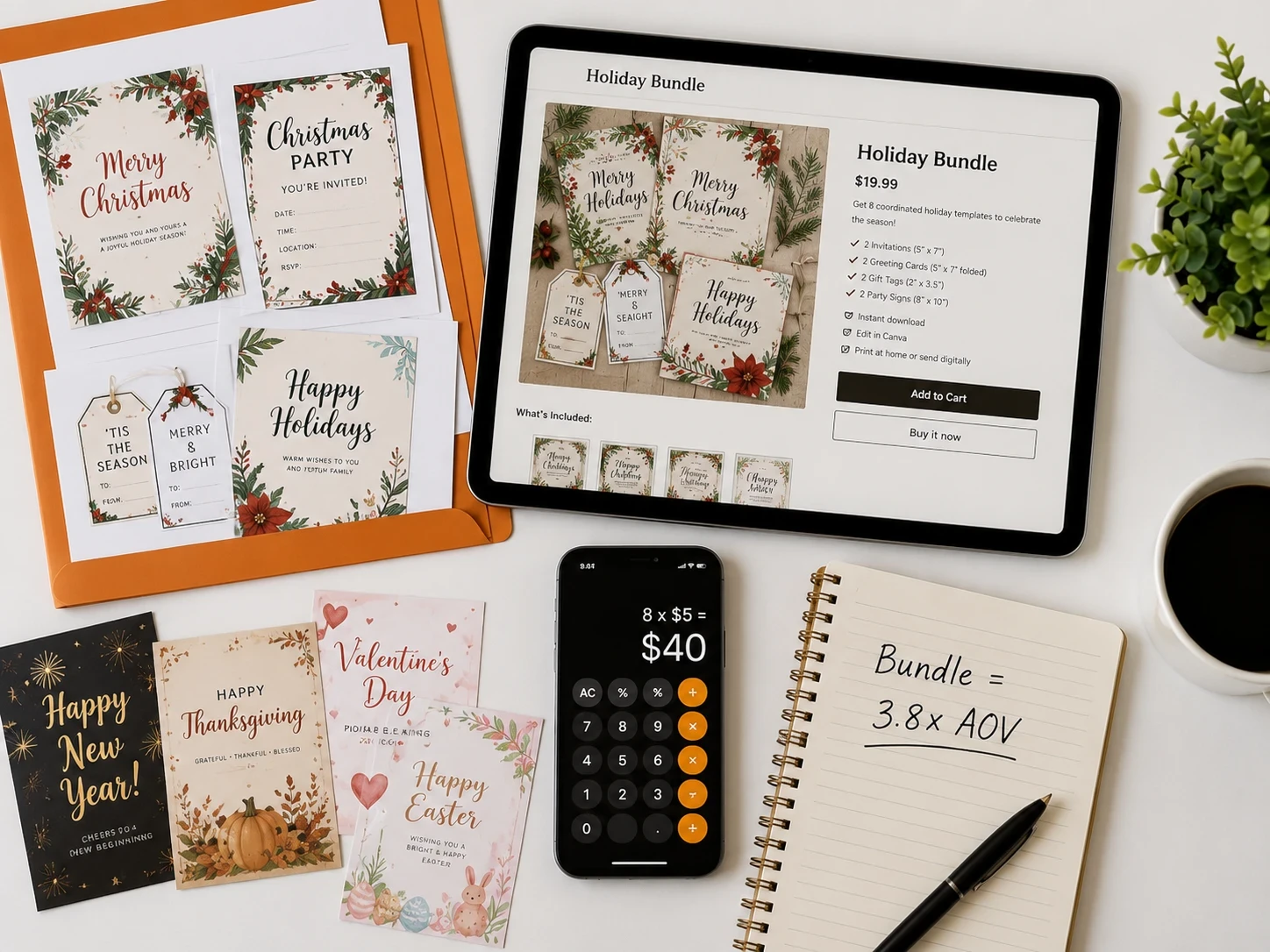
Here is a simple calculation that makes the bundle obvious to buyers:
8 individual Christmas templates x $5 each = $40 total. Bundle price: $19. The buyer saves $21, and you earn 3.8x more per transaction than selling a single template. Bundles also reduce support volume because the buyer gets everything in one download instead of making eight separate purchases.
Not every season commands the same price. Q4 (Halloween through Christmas) is the premium window. Buyers expect to spend more, and the emotional stakes are higher. A Christmas card template bundle at $24.99 will convert in December, while the same bundle themed for a random Tuesday in March probably won't. Price your Q4 products 30% to 50% higher than your Q1/Q2 products.
For more strategies on pricing digital product bundles effectively, check our guide on best free and low-cost Shopify apps for selling digital products, which also covers tools that support bundle delivery.
Use flash sales during the shoulder season (the 2 weeks after a holiday peak) to clear remaining seasonal inventory perception. A "Last Chance: Valentine's Day Templates 40% Off" email on February 16 captures late shoppers and people already planning for next year.
The risk with a purely seasonal business is the gap between peaks. A seller who only creates Q4 products faces 9 months of minimal revenue. The solution is layering seasonal products on top of an evergreen foundation.
Aim for roughly 60% of your catalog to be evergreen (budget planners, resume templates, social media kits) and 40% seasonal. Evergreen products provide baseline monthly income. Seasonal products create spikes. Together, they smooth your revenue curve.
One printable seller described her approach: she maintains about 30 evergreen products that sell year-round (chore charts, meal planners, budget trackers) alongside more than 100 seasonal listings. The evergreen products generate consistent baseline sales, while the seasonal products drive the spikes that push monthly revenue from steady to exciting.
A "Weekly Meal Planner" is evergreen. A "Thanksgiving Week Meal Planner with Shopping List and Prep Timeline" is seasonal but uses 80% of the same design. Create your evergreen template first, then produce seasonal variants by changing colors, adding holiday-specific sections, and updating the cover image. This takes 30 minutes per variant instead of 4 hours for a new product.
Every seasonal purchase is a chance to capture an email address. Use Shopify's post-purchase page or your download delivery email to invite buyers to join your list for "early access to next season's designs." A buyer who purchased your Halloween party kit in October is a warm lead for your Christmas collection in November. This is the single most important difference between selling seasonal products on your own Shopify store versus a marketplace: you own the customer relationship.
Printable planners, holiday card templates, party invitation bundles, and seasonal wall art consistently perform well. Products tied to high-spending holidays (Christmas, Valentine's Day, Mother's Day) tend to generate the highest per-product revenue. Back-to-school products also perform strongly because parents and teachers are repeat buyers who purchase in August every year.
List your seasonal products 6 to 8 weeks before the event for SEO indexing, and begin marketing them 4 weeks before. For Q4 products (Halloween through Christmas), list even earlier, by September at the latest. Shopify product pages need time to be crawled and ranked by search engines, so listing a Christmas product on December 1 means you've already missed the majority of search traffic.
Yes. Unlike physical products, digital products don't expire. A "2026 Christmas Card Template" can be updated to "2027 Christmas Card Template" with a new cover image and minor design refresh. The underlying template stays the same. This is one of the most appealing aspects of seasonal digital products: you build the catalog once and maintain it with minimal updates each year.
You need a digital delivery app on your Shopify store. Big Digital Downloads handles automatic delivery by sending customers a download page and email with their files immediately after purchase. It supports all common digital product formats (PDF, PNG, ZIP, MP4) and lets you set download limits and expiration windows. The free plan supports up to 250MB of storage and 50 orders, making it a practical starting point for new seasonal sellers.
Absolutely. While holidays like Thanksgiving and the Fourth of July are US-specific, events like Christmas, Easter, Valentine's Day, Mother's Day, and back-to-school are global. Wedding season runs from May through September in the Northern Hemisphere and November through March in the Southern Hemisphere, effectively doubling your selling window if you market to both. Many Shopify sellers also create products for region-specific events like Diwali, Lunar New Year, and Carnival.
Building a seasonal digital product business isn't about chasing one holiday and hoping for the best. It's about mapping the full year, building a reusable template system, listing products weeks before demand peaks, and layering seasonal spikes on top of an evergreen foundation. The sellers who do this consistently, not the ones who create the prettiest designs, are the ones earning $2,000+ months from digital downloads. If you're running a Shopify store and want automatic delivery, download limits, and PDF stamping handled for you, Big Digital Downloads is built for exactly this workflow.